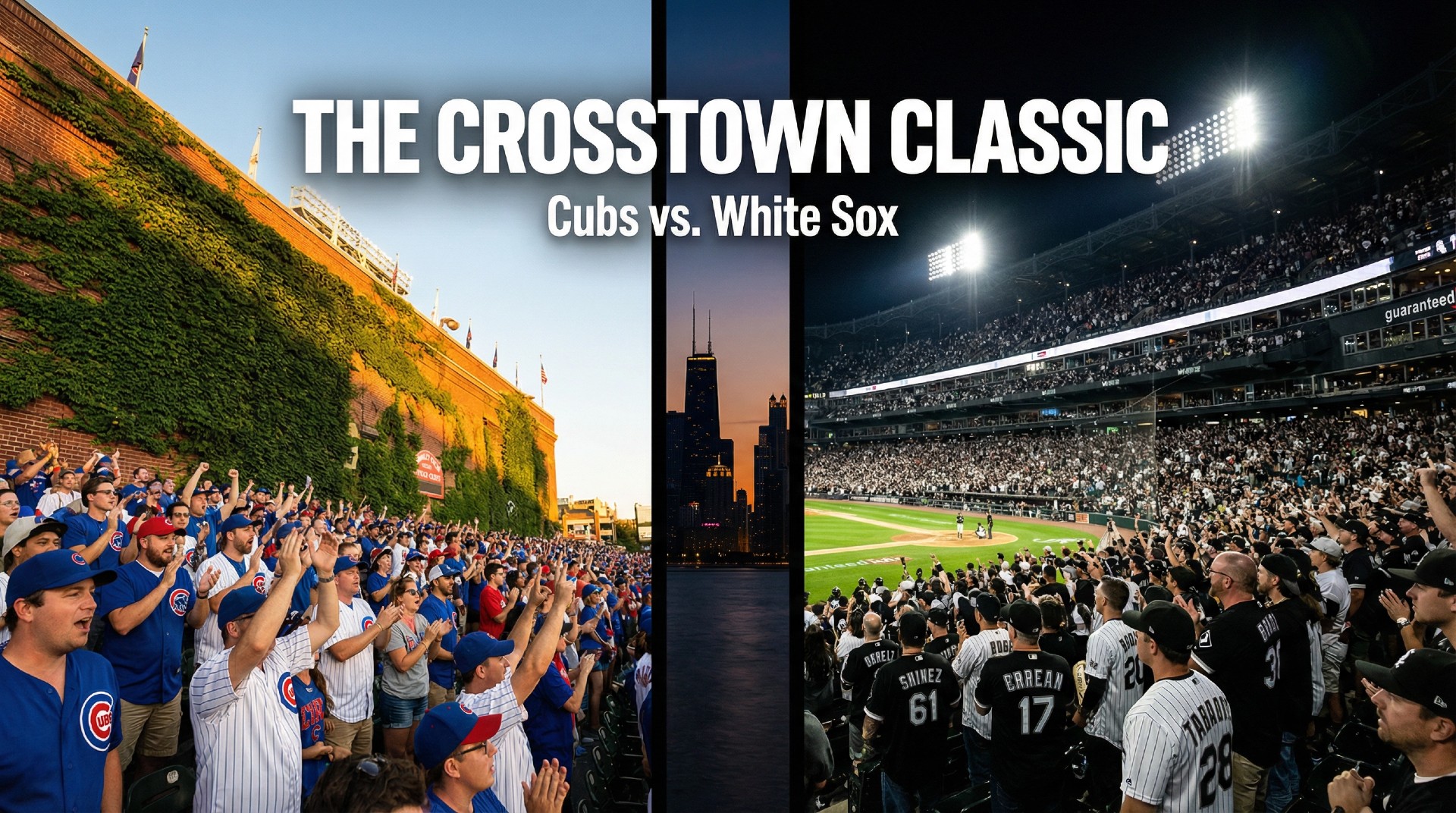
The Crosstown Classic: Why the Cubs vs. White Sox Rivalry is the Beating Heart of Chicago Baseball
If you live in Chicago, you know the question. It’s not "Where did you go to high school?" or "Deep dish or tavern style?" (though those matter, too). The real question, the one that defines your summer, your wardrobe, and sometimes even your family dynamics, is simple: Cubs or Sox?
The Crosstown Classic isn’t just a series of baseball games. It’s a cultural event, a neighborhood turf war, and a family feud all rolled into one. When the Chicago Cubs and the Chicago White Sox meet on the diamond, the city splits right down the middle. The Red Line becomes a battleground of pinstripes and Cubbie blue, and for a few days every summer, nothing else matters. But why do we care so much? What makes this rivalry so intense, so enduring, and so undeniably Chicago?
A Rivalry Born in the World Series
To understand the Crosstown Classic, you have to go back to the beginning. The rivalry didn’t start with interleague play in 1997; it started in 1906, when the two teams met in the World Series [1]. It was the first time in Major League Baseball history that two teams from the same city faced off for the championship [2].
The Cubs were the heavy favorites. They had won a staggering 116 games in the regular season, a record that still stands today [2]. The White Sox, on the other hand, were known as the "Hitless Wonders," having won 93 games with a lineup that struggled to put the ball in play [1]. But in a stunning upset, the White Sox beat the Cubs four games to two, claiming the championship and setting the stage for a century of bragging rights [2].
For decades after that, the two teams only met in exhibition games, like the City Series and the Windy City Classic charity games [1]. But the animosity was always there, simmering just beneath the surface. When regular-season interleague play finally began in 1997, the rivalry exploded into the modern era, giving fans a guaranteed chance to talk trash every single year [2].
North Side vs. South Side: A Tale of Two Fanbases
The Cubs-Sox rivalry is about more than just baseball; it’s about geography, class, and identity. The Cubs play at Wrigley Field on the North Side, a historic, ivy-covered ballpark nestled in a bustling, affluent neighborhood [1]. Cubs fans are often stereotyped as the "yuppie" crowd—people who go to the game for the atmosphere, the beer, and the sunshine as much as for the baseball itself.
The White Sox play at Rate Field (formerly Comiskey Park and U.S. Cellular Field) on the South Side [2]. Sox fans proudly embrace a blue-collar, gritty identity. They see themselves as the die-hards, the fans who care more about the score than the social scene. As one fan famously put it, "Chicago is a blue-collar town," and the White Sox represent that hardworking ethos.
Of course, these are just stereotypes. You’ll find die-hard baseball nerds in the bleachers at Wrigley, and you’ll find casual fans enjoying a tailgate at Rate Field. But the narrative persists because it gives the rivalry its flavor. It’s the North Shore versus the South Side, the "Friendly Confines" versus the "Grinder Rules." It’s a clash of cultures that makes every pitch feel a little more important.
The Moments That Define the Classic
Over the years, the Crosstown Classic has delivered some of the most unforgettable moments in Chicago sports history. Who could forget the infamous 2006 brawl? White Sox catcher A.J. Pierzynski collided with Cubs catcher Michael Barrett at home plate, slapping the plate in celebration. Barrett responded with a right hook to Pierzynski’s jaw, clearing both benches and cementing the rivalry’s reputation for bad blood [2].
Then there are the streaks and the sweeps. The Cubs hold the record for the longest winning streak in the rivalry, taking eight straight games from August 2023 to May 2025 [2]. But the White Sox have had their moments of dominance, too, including a five-game winning streak from 2009 to 2010 [1].
The introduction of the Crosstown Cup in 2010 added a physical trophy to the mix, giving the winning team something to hoist in front of their rivals [2]. Whether it’s a blowout victory or a tense, extra-inning thriller, the games always seem to deliver drama.
The 2025 Series: A Snapshot of the Rivalry
The 2025 season provided a perfect example of why the Crosstown Classic is so compelling, even when the teams are heading in different directions. The Cubs came into the series pushing for a playoff spot, while the White Sox were mired in a historically bad season, on pace for over 100 losses [3].
But in a rivalry game, records go out the window. The series was fiercely contested, with the Cubs ultimately taking five out of six games across the season [3]. The final game at Rate Field was a microcosm of the rivalry: the Cubs jumped out to an early lead, the White Sox fought back with two home runs from Andrew Benintendi, but the Cubs held on for a tense 5-4 victory [3].
For Cubs fans, it was a crucial win in a playoff race. For White Sox fans, it was a bitter pill to swallow, a reminder of a lost season made worse by losing to the team up north. But even in defeat, the passion was there. The stadium was packed, the cheers and boos were deafening, and for nine innings, the city was completely captivated.
Looking Ahead to 2026
As we look ahead to the 2026 season, the all-time regular-season series is incredibly close. Heading into the year, the Cubs hold a narrow 77-75 edge in regular-season matchups [1]. If you include the 1906 World Series, the all-time record is tied at 79-79 [2].
The 2026 Crosstown Classic will feature a weekend series at Rate Field from May 15-17, followed by a series at Wrigley Field from August 17-19 [2]. For fans on both sides of town, those dates are already circled on the calendar.
Why We Care
So why do we care so much? Why do we argue with our coworkers, tease our family members, and spend exorbitant amounts of money on tickets to these games?
We care because the Crosstown Classic is Chicago. It’s a reflection of our city’s history, its neighborhoods, and its unyielding passion for sports. It’s a chance to defend your turf, to celebrate your identity, and to experience the thrill of victory (or the agony of defeat) alongside thousands of your neighbors.
Whether you bleed Cubbie blue or wear the black and white, the Crosstown Classic is a reminder of why we love baseball. It’s not just a game; it’s a tradition. And in Chicago, tradition means everything.
