South Loop Landlords: Why Your Tenants Can't Reach Your Contractor When It Matters Most
If you own rental property in the South Loop, you already know the math. With nearly 60% of the neighbourhood’s 12,400 households occupied by renters, the demand for your condo or loft is high . But so are the expectations. South Loop tenants—many of them young professionals paying upwards of $2,300 to $2,800 a month—expect premium service .
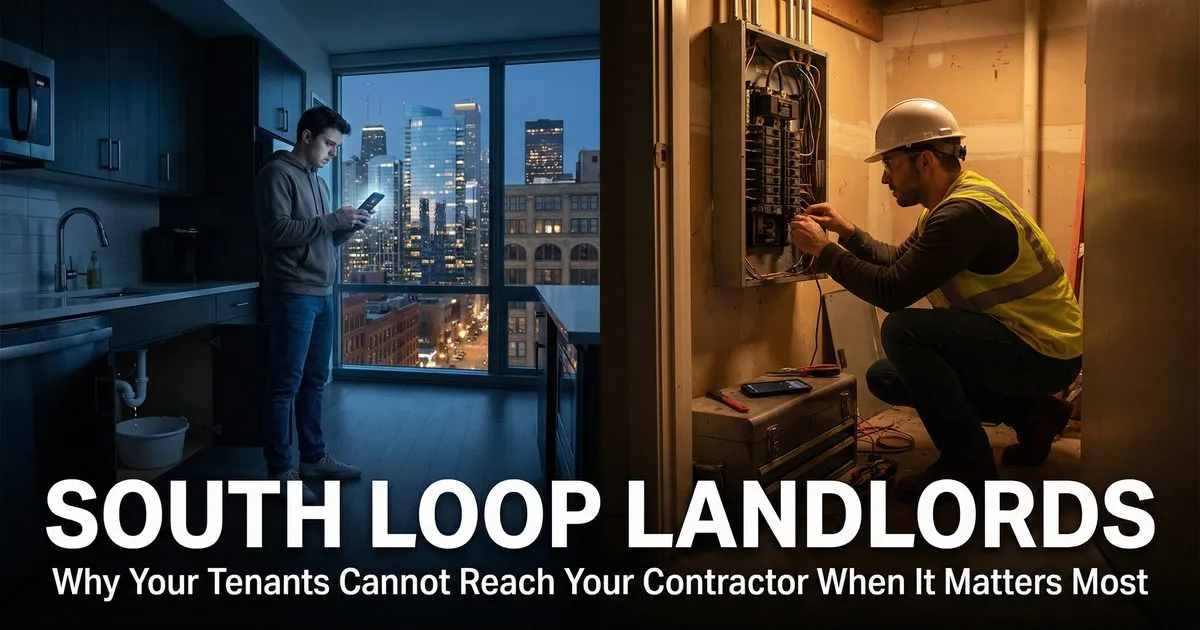
So, what happens when the HVAC goes out in July, or a pipe bursts at 9:00 PM on a Friday? You do what any responsible landlord does: you give the tenant your trusted contractor’s number.
And then... nothing happens. The tenant calls. It goes to voicemail. They text. No reply. By Saturday morning, your tenant is furious, water is damaging your hardwood floors, and you are scrambling to find an overpriced emergency backup.
Let’s cut through the BS. Your contractor isn't ignoring your tenant because they are lazy. They are ignoring them because the traditional home services communication model is fundamentally broken. Here is why your tenants can't reach your contractor when it matters most—and how you can fix it before it costs you your next lease renewal.
The Reality of the Job Site
It is easy to sit in a quiet office and wonder why a plumber isn't answering their phone. But let’s look at the reality of contracting work.
Contractors are not missing calls because they are disorganized; they are missing calls because their work is inherently incompatible with being on the phone . When your tenant calls your HVAC guy at 2:00 PM on a Tuesday, that contractor might be:
•Installing a condenser unit on a roof in 95-degree heat.
•Wedged under a sink in a tight crawl space.
•Wiring an electrical panel where taking their hands off the job is a safety hazard.
•Running heavy machinery where they literally cannot hear the phone ring.
Industry data shows that a staggering 62% of calls to contractors go unanswered simply because the crew is on a job site .
The Voicemail Trap
"Just leave a voicemail," you tell your tenant. But here is the harsh truth: 78% of callers will not leave a voicemail.
In the age of instant gratification, a tenant dealing with a broken AC or a leaking ceiling does not want to leave a message and hope for the best. If a contractor does not answer, the tenant’s immediate reaction is panic, followed by anger directed at you, the landlord.
Even if the tenant does leave a voicemail, the average callback delay in the contracting industry is 4.2 hours . By the time your contractor finally climbs down from the ladder and checks their messages, the damage to your property—and your relationship with your tenant—is already done.
The After-Hours Emergency Nightmare
The South Loop is a 24/7 neighbourhood, and property emergencies do not respect business hours. In fact, 31% of emergency maintenance calls happen after hours.
If your contractor relies on a traditional receptionist, that person goes home at 5:00 PM. If they use a cheap answering service, your tenant gets stuck talking to a generic operator who doesn't understand the property, can't troubleshoot the issue, and just creates a frustrating game of phone tag .
When a tenant cannot reach help during an after-hours emergency, they often resort to calling the City of Chicago's 311 system to file a building complaint . Once the city gets involved, you are no longer just dealing with a maintenance issue; you are dealing with potential code violations, inspections, and legal headaches.
The True Cost to South Loop Landlords
When your tenant can't reach your contractor, you pay the price in three distinct ways:
1. Escalating Repair Costs
A minor leak that could have been fixed for $200 on Friday evening becomes a $2,500 drywall and flooring nightmare by Monday morning. When your primary contractor is unreachable, you are forced to hire whoever is available, often paying exorbitant emergency dispatch fees.
2. Tenant Turnover
South Loop renters have options. The median age in the neighbourhood is 32, and these young professionals value convenience and responsiveness above almost everything else . If they feel abandoned during a maintenance crisis, they will not renew their lease. In a market where condos average 20–30 days on the market between tenants, a single vacancy can cost you thousands in lost rent .
3. Reputation Damage
In luxury and premium rental markets, word travels fast. A tenant who feels ignored will leave negative reviews, complain to the condo association, and warn other potential renters.
The Solution: Stop Relying on Phone Tag
If you want to protect your South Loop investment and keep your tenants happy, you need to stop relying on a broken communication loop. Here is how to fix it:
1. Centralize the Communication:Never make your tenant the middleman. Tenants should report issues directly to a centralized system (like a property management portal or a dedicated landlord emergency line), not directly to the contractor's personal cell phone.
2. Implement Smart Automation:Forward-thinking landlords and property managers are moving away from traditional answering services and adopting automated, AI-driven communication tools like GoHighLevel (GHL). These systems can instantly capture a tenant's maintenance request, categorize it by urgency, and automatically dispatch alerts to multiple contractors simultaneously until one accepts the job.
3. Establish Clear Emergency Protocols:Define exactly what constitutes an emergency (e.g., active flooding, no heat in winter, gas leaks) versus a routine repair . Provide your tenants with a clear, written protocol on day one of their lease. If an emergency happens, they should know exactly who to call, and that system should guarantee an immediate response—even if it is an automated triage system that dispatches the on-call vendor.
4. Partner with Modern Contractors:When vetting contractors for your South Loop property, ask about their communication stack. Do they use job-tracking software? Do they have an automated booking system? If their entire business runs off a single iPhone that goes straight to voicemail, they are a liability to your rental business.
Your South Loop rental property is a premium asset. It is time to ensure your maintenance communication reflects that.
