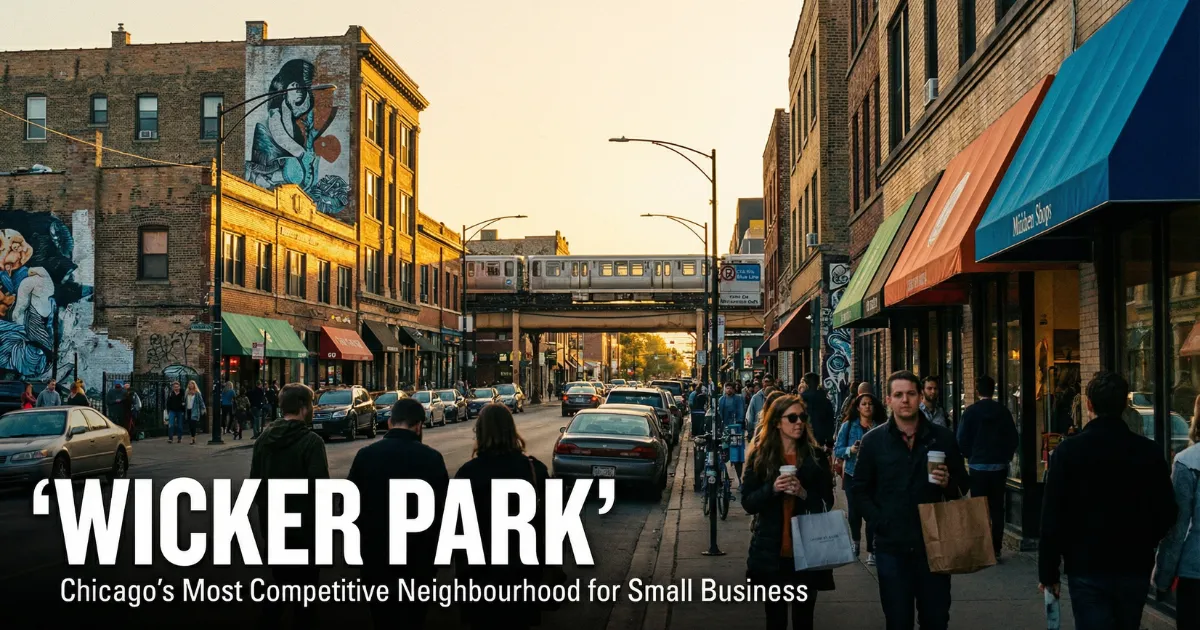
Neighbourhood Spotlight — Wicker Park: Why Wicker Park Is Chicago's Most Competitive Neighbourhood for Small Business
Walk down Milwaukee Avenue on a Saturday afternoon, and the energy is palpable. The sidewalks are packed with a mix of young professionals, artists, and tourists. The CTA Blue Line rumbles overhead, and the storefronts—a vibrant mix of high-end national brands and fiercely independent local shops—are bustling. This is Wicker Park, arguably Chicago's trendiest neighbourhood and undeniably its most competitive battleground for small businesses.
With approximately 1,400 businesses operating within the Wicker Park and Bucktown area [1], the commercial landscape here is as dynamic as it is cutthroat. But what makes Wicker Park such a magnet for entrepreneurs, and why is it so difficult to survive here? The answer lies in a complex mix of demographics, real estate economics, and a neighbourhood identity that is constantly evolving.
The Allure of the "Six Corners"
To understand Wicker Park's business appeal, you have to look at who lives there and who visits. The neighbourhood boasts a population of over 24,000 residents, with a median age of 32 and an average individual income exceeding $100,000 [2]. This young, affluent demographic is the holy grail for retailers and restaurateurs.
Furthermore, Wicker Park is incredibly accessible. The intersection of Milwaukee, Damen, and North Avenues—often referred to locally as the "Six Corners" (though purists will argue the true Six Corners is in Portage Park)—is anchored by a CTA Blue Line station that funnels thousands of commuters and visitors into the neighbourhood daily [3]. Add in the foot traffic generated by The 606 (the Bloomingdale Trail), an elevated rail-to-trail park that runs along the neighbourhood's northern edge, and you have a recipe for massive retail exposure [3].
Entrepreneurs are drawn to this built-in audience. As one local boutique owner noted, Wicker Park is a place that "accepts trendy fashion, and innovates all the time" [4]. It is a neighbourhood where a niche concept—whether it's a specialized vinyl record store or an organic vegan cafe—can find a dedicated customer base.
The Price of Popularity: The Rent Squeeze
However, the very factors that make Wicker Park attractive also make it incredibly expensive. The neighbourhood has undergone decades of gentrification, transforming from a working-class immigrant enclave in the mid-20th century to an artist haven in the 1980s and 90s, and finally into the luxury commercial district it is today [3].
This evolution has sent commercial real estate prices skyrocketing. Recent reports from 2026 indicate that a fully leased retail building on North Milwaukee Avenue sold to a New York investor for $5.6 million, while another retail portfolio in the area sold for $5.1 million [5]. When investors pay top dollar for commercial properties, rents inevitably rise to ensure a return on investment.
For small business owners, the math is becoming increasingly difficult. According to local business owners and community discussions, commercial rents on the prime Damen Avenue strip can run between $25,000 and $35,000 per month under "triple net" leases (where the tenant pays rent plus property taxes, insurance, and maintenance) [6]. Even off the main strips, rents of $8,000 to $9,000 a month for a 2,000-square-foot restaurant space are common [6].
Because Illinois does not cap commercial property taxes, rising property values directly translate to higher tax burdens for tenants [6]. This economic pressure creates a high turnover rate. As one local observer noted, "Rents are expensive in the area, and changing economic conditions are such that companies are less willing to keep less profitable, or even unprofitable, stores open even if the neighborhoods are trendy, or foot traffic is good" [6].
The Invasion of the Flagships
The rising costs have fundamentally changed the types of businesses that can afford to operate in Wicker Park. Over the last decade, the neighbourhood has seen an influx of national and global brands—such as Lululemon, Arc'teryx, Yeti, and Barnes & Noble [6].
For these massive corporations, a Wicker Park storefront isn't necessarily about turning a massive profit on daily sales; it's about brand positioning. These locations often serve as "cost-center flagship-style stores that exist solely to advertise the brand" [6]. They can afford to absorb high rents and property taxes as a marketing expense, a luxury that independent mom-and-pop shops simply do not have.
This dynamic mirrors the changes seen in other booming Chicago areas like Fulton Market, where chains are driving up rents and fueling fears that the local, independent character of the neighbourhood is being erased [7]. When a national brand falters or shifts strategy—as seen with recent closures of Yeti and Club Monaco in the area—they leave behind massive, expensive vacancies that are difficult for independent businesses to fill [6].
The Survival of the Independents
Despite these immense pressures, Wicker Park remains a stronghold for independent businesses, thanks largely to a fierce "buy local" culture. The Wicker Park Bucktown Chamber of Commerce actively promotes initiatives to keep money within the community, managing the local Special Service Area and organizing massive events like Wicker Park Fest, which draws tens of thousands of visitors every summer [1].
There are also the legacy businesses that have managed to weather the storms of gentrification. Institutions like Myopic Books, one of Chicago's oldest and largest used bookstores, and Quimby's Bookstore, a haven for zines and independent comics, continue to thrive [6]. These businesses survive because they offer something that cannot be replicated by a national chain or an online retailer: authentic community connection and a highly curated, unique experience.
As one local record store owner put it, operating an independent business in Wicker Park is "a real labor of love" [4]. The businesses that succeed here are those that deeply understand their clientele, offer exceptional and unique products, and actively engage with the community.
The Future of Wicker Park Commerce
Wicker Park is at a crossroads. It remains one of the most desirable retail locations in the Midwest, but the barrier to entry has never been higher. The neighbourhood is a microcosm of the broader challenges facing urban retail today: how to balance the economic realities of booming real estate with the desire to maintain a unique, independent neighbourhood character.
For entrepreneurs, Wicker Park is the ultimate proving ground. If a small business can survive the high rents, the intense competition from global brands, and the discerning tastes of the local demographic, it can survive almost anywhere. It is a high-risk, high-reward environment that continues to define the cutting edge of Chicago commerce.
