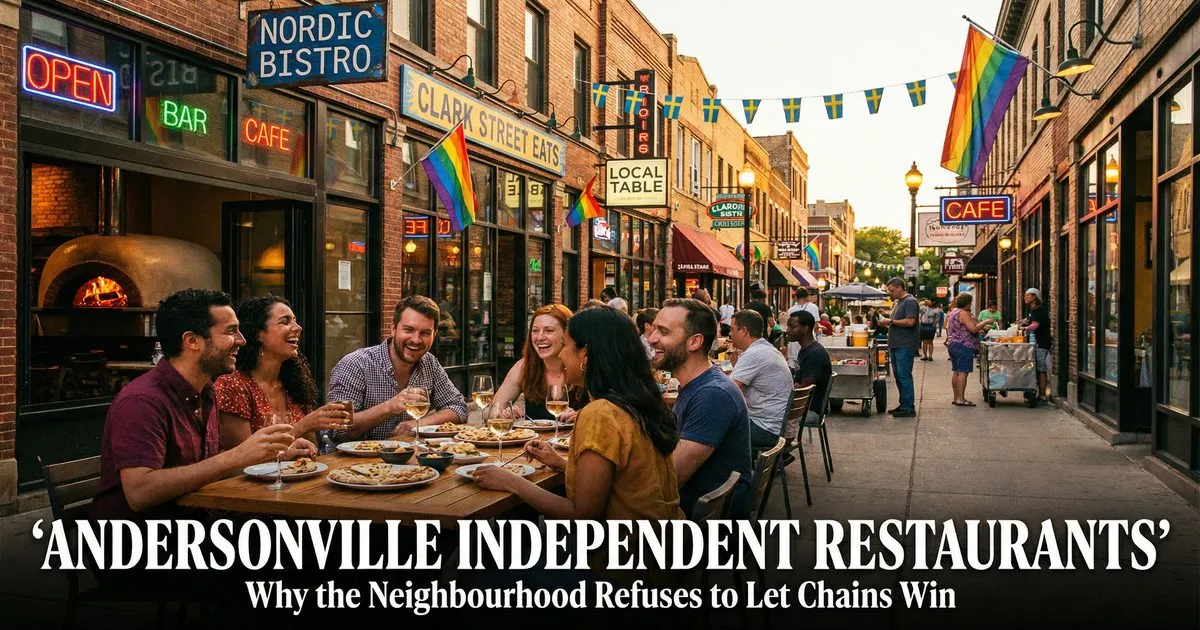
Food & Hospitality: Andersonville's Independent Restaurant Scene: Why the Neighbourhood Refuses to Let Chains Win
Walk down North Clark Street on a Friday evening, and you will notice something missing. There are no golden arches. There are no glowing green mermaid sirens. There are no massive, cookie-cutter casual dining facades.
Instead, Andersonville’s main commercial corridor is a vibrant, eclectic patchwork of family-owned bistros, queer-owned cocktail bars, and chef-driven passion projects. From the Israeli-inspired wood-fired ovens at Fiya to the legendary Southern comfort food at Big Jones, Andersonville is fiercely, unapologetically independent .
In 2026, as the national restaurant industry faces a wave of corporate consolidation and chain expansion, Andersonville stands as a defiant outlier. The neighbourhood has earned the title of the "Shop Local Capital of Chicago," boasting over 300 independent businesses within a 1.5-mile radius . But how does this North Side enclave manage to keep the corporate giants at bay, and why do its independent restaurants continue to thrive when so many others fail?
The Economics of the "Shop Local" Multiplier
The survival of Andersonville’s independent restaurants is not just a matter of neighbourhood charm; it is grounded in hard economics.
When a diner spends money at a national chain restaurant, a significant portion of that revenue immediately leaves the community, funnelled up to corporate headquarters. However, when that same dollar is spent at an independent local restaurant, the economic multiplier effect is profound. Studies show that independent restaurants recirculate approximately 68.4% of their revenue back into the local economy .
This recirculation happens through local payroll, profits retained by local owners, charitable giving, and—crucially—B2B spending. An independent Andersonville restaurant is far more likely to hire a local accountant, use a local printer for menus, and source ingredients from regional farms. In contrast, major national restaurant chains return an average of just 30.4% of their revenue to the local market .
Andersonville residents understand this math intuitively. The neighbourhood’s Chamber of Commerce has spent decades cultivating a culture where spending money locally is viewed as a civic duty . For Andersonville diners, choosing a local spot over a chain is not just a culinary preference; it is an investment in their own community's resilience.
A Culture of Inclusivity and Identity
Andersonville’s resistance to corporate homogenization is deeply tied to its cultural history. Originally settled by Swedish immigrants in the 19th century, the neighbourhood evolved in the late 20th century into a haven for Chicago’s LGBTQ+ community, earning the informal moniker "Girlstown" due to its strong concentration of lesbian-owned businesses .
Today, that legacy of progressive social activism and inclusivity is baked into the neighbourhood's dining scene. Venues like Nobody’s Darling, a queer, Black-female-owned cocktail bar, and the iconic Women & Children First bookstore serve as community anchors .
Chain restaurants, by design, are built to appeal to the broadest possible demographic. They rely on standardized menus, sanitized aesthetics, and risk-averse branding. This corporate neutrality fundamentally clashes with Andersonville’s identity. The neighbourhood demands authenticity, diversity, and a point of view—qualities that independent operators like Jin Ju (serving Korean comfort food since 2001) or Minyoli (a beloved Taiwanese spot) deliver effortlessly . A chain restaurant simply cannot replicate the hyper-local, culturally nuanced experience that Andersonville diners expect.
The 2026 Shift: From Survival to Strategy
The past few years have been brutal for independent restaurants nationwide. Between 2024 and 2025, the total number of independent restaurants in the U.S. declined by 2.5%, reflecting a net loss of more than 9,500 locations, while chain locations actually increased .
Yet, in 2026, the independent operators who survived the pandemic-era chaos are emerging stronger and more strategic. Industry analysts note that 2026 is a pivotal year of "renewal" for independent restaurants . Rather than chasing every new food trend or relying on opportunistic marketing, successful operators are rebuilding their foundations.
In Andersonville, this strategic maturity is evident. Restaurants are optimizing their menus for profitability rather than sheer variety. They are investing in better back-of-house technology to manage labor costs and streamline operations. And they are leaning heavily into community events. Initiatives like Andersonville Restaurant Weeks and the massive Midsommarfest street festival are not just marketing stunts; they are highly coordinated, collaborative efforts designed to drive foot traffic and reinforce the neighbourhood's collective brand .
The High Barrier to Entry for Chains
While community loyalty is the primary shield against chain restaurants, the physical reality of Andersonville also plays a role.
North Clark Street is characterized by historic, low-rise brick buildings with relatively small footprints . These spaces are perfect for a cozy 40-seat bistro or a specialized bakery like Lost Larson, but they are a logistical nightmare for large casual dining chains .
National chains typically require massive square footage, dedicated parking lots, and standardized build-outs that do not fit within Andersonville’s historic zoning constraints. The high cost of retrofitting these older buildings, combined with the neighbourhood's vocal opposition to corporate variances, creates a natural barrier to entry. For a chain executive looking at a map of Chicago, Andersonville is simply too difficult and too hostile a market to penetrate.
A Blueprint for the Future
Andersonville proves that the slow death of the independent restaurant is not inevitable. By fostering a fierce "shop local" ethos, protecting its unique cultural identity, and supporting operators who prioritize strategic, sustainable growth, the neighbourhood has created a micro-economy where independents can actually win.
As the rest of the country grapples with the homogenization of its main streets, Andersonville offers a different vision. It is a neighbourhood that understands that the soul of a city is found in its independent businesses—and it is willing to fight to keep it that way.
