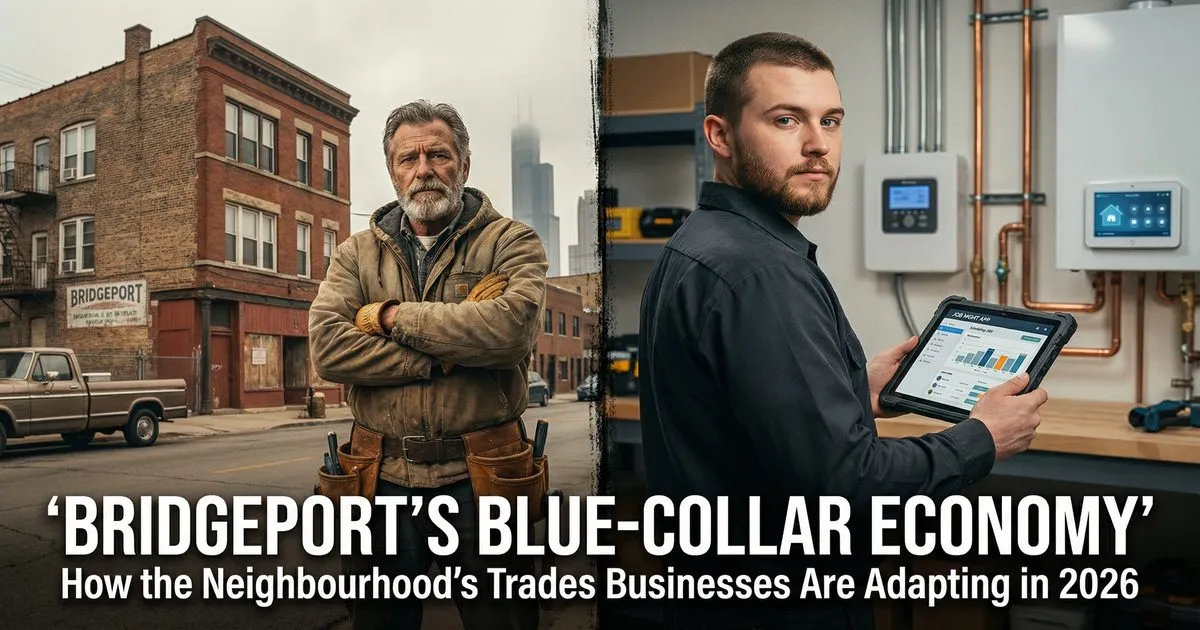
Chicago Business: Bridgeport's Blue-Collar Economy: How the Neighbourhood's Trades Businesses Are Adapting in 2026
Bridgeport has always been a neighbourhood built on calluses and concrete. Bounded by the South Branch of the Chicago River, this South Side enclave was originally settled in the 1830s by the Irish immigrants who dug the Illinois & Michigan Canal by hand . For generations, it was the undisputed capital of Chicago’s working class—a place where stockyard workers, factory hands, and tradesmen built a tight-knit, fiercely loyal community that eventually produced five Chicago mayors .
Today, the stockyards are gone, and the factories have largely been converted into art studios and lofts. The demographics have shifted, with a growing Chinese American and Latino population joining the legacy Irish and Eastern European families . Yet, despite these changes, Bridgeport’s blue-collar DNA remains intact.
In 2026, the neighbourhood is still home to a dense concentration of independent plumbing, electrical, HVAC, and general contracting businesses. But the rules of the game have changed. As the home services industry undergoes a massive technological shift, Bridgeport’s trades businesses are proving that "old school" grit and modern innovation are not mutually exclusive. Here is how the neighbourhood's blue-collar economy is adapting to survive and thrive.
The Generational Shift and the "Readiness Gap"
The most pressing challenge facing Bridgeport’s trades businesses in 2026 is not a lack of demand—it is a lack of seasoned hands.
The skilled trades are currently experiencing a massive generational shift. The master plumbers and veteran electricians who built their businesses in the 1980s and 90s are retiring, taking decades of institutional knowledge and site intuition with them . In their place comes Generation Z.
While Gen Z workers are highly digitally fluent, they often lack the mechanical foundation of their predecessors. Furthermore, data shows that 82% of Gen Z workers are confident they can quickly acquire new skills, but 31% will leave a job within a year if they do not see clear advancement opportunities .
To adapt, Bridgeport contractors are restructuring how they train. Instead of the traditional "shadow me for five years" apprenticeship model, local businesses are implementing structured, accelerated onboarding programs. They are pairing retiring veterans with young recruits specifically to document and transfer knowledge before it walks out the door.
Embracing the Digital Toolbelt
For decades, a Bridgeport contractor’s back office consisted of a spiral-bound ledger, a carbon-copy invoice pad, and a landline phone. In 2026, that model is a guaranteed path to bankruptcy.
The home services market is projected to surpass $1 billion annually by 2029, and consumer expectations have evolved . Today’s homeowners—especially the younger demographics moving into Bridgeport’s newly converted lofts—expect seamless digital convenience. They want online scheduling, transparent upfront pricing, and instant digital quotes .
Bridgeport’s surviving trades businesses have traded the ledger for the cloud. The adoption of Field Service Management (FSM) software is now the baseline standard . These platforms allow a three-person HVAC crew to operate with the efficiency of a corporate fleet, handling dispatching, inventory management, and real-time technician tracking from a single iPad.
Furthermore, the integration of AI is changing how these businesses handle customer service. Automated, AI-driven receptionists are now answering after-hours emergency calls, qualifying leads, and booking appointments while the crew is asleep or under a sink, ensuring that no revenue slips through the cracks .
The Rise of "New-Collar" Work
The narrative that AI and automation will destroy the working class is largely a white-collar anxiety. In the trades, technology is not replacing the worker; it is augmenting them.
Industry experts are increasingly referring to modern tradespeople as "new-collar" workers . In 2026, a Bridgeport HVAC technician is not just turning wrenches; they are diagnosing complex, IoT-connected smart home systems, calibrating electric heat pumps, and working with low-GWP (Global Warming Potential) refrigerants mandated by new environmental regulations .
Similarly, electricians are pivoting to meet the surging demand for EV charging station installations and smart-panel upgrades, while plumbers are installing advanced leak-detection sensors and graywater recycling systems . The businesses that are thriving in Bridgeport are the ones investing heavily in continuous education, ensuring their crews are certified to handle the high-tech hardware that modern homes require.
Competing with the Private Equity Giants
The profitability of the home services sector has not gone unnoticed by Wall Street. Over the past few years, private equity firms have aggressively rolled up independent HVAC and plumbing companies across the Midwest, rebranding them under massive corporate umbrellas.
For a family-owned Bridgeport business, competing on marketing spend against a private equity-backed giant is impossible. Instead, local contractors are leaning into their greatest asset: their deep community roots.
Bridgeport businesses are adapting by hyper-personalizing their service and emphasizing trust . They are shifting toward subscription-based maintenance models—offering homeowners peace of mind through regular, scheduled check-ups rather than waiting for an emergency break-fix call . By building recurring revenue streams and leveraging their multi-generational reputation in the neighbourhood, these independent shops are insulating themselves against corporate encroachment.
The Future of the South Side Hustle
Bridgeport’s median household income sits at a solid $73,366, and the neighbourhood remains a bastion of the middle class . The trades businesses anchored here are a primary reason why.
In 2026, the blue-collar economy is not dying; it is upgrading. By embracing digital transformation, adapting to a new generation of workers, and mastering the high-tech systems of the modern home, Bridgeport’s contractors are proving that the South Side hustle is as resilient as ever. They may have traded the carbon-copy invoice for a cloud-based app, but the work ethic remains exactly the same.
